
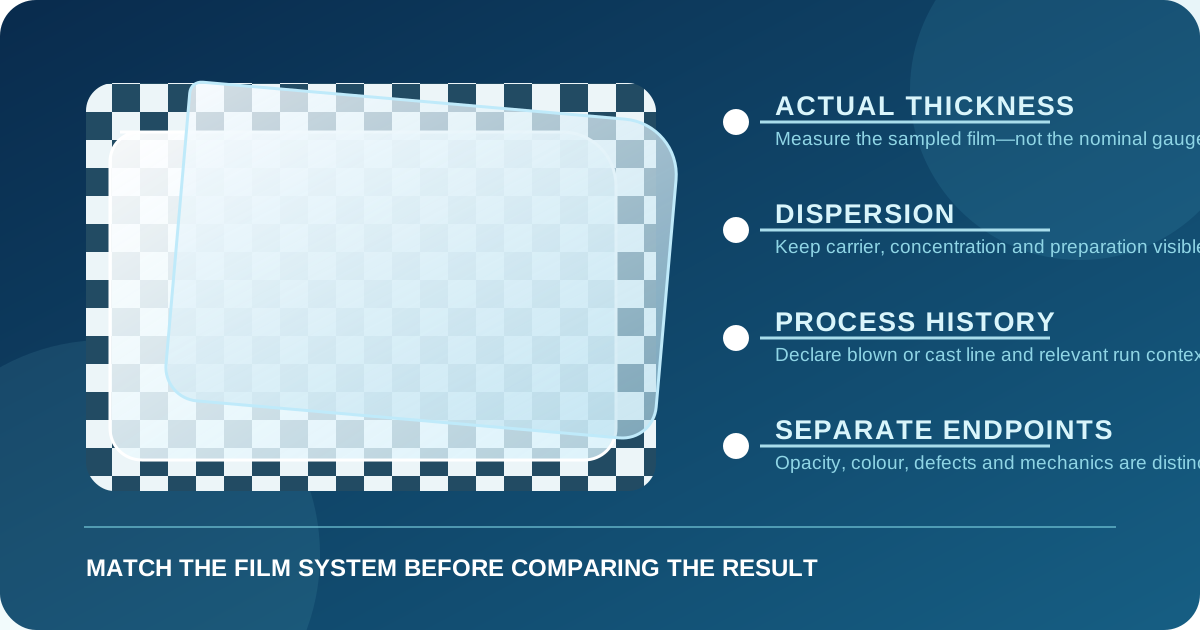
1. A film label is not finished-film proof
A “film grade,” pigment data sheet, supplier graph, or white-masterbatch claim describes an input. On its own, it cannot tell a film-fabrication team how that input will perform in its finished construction. The practical question is whether the available evidence justifies a controlled comparison in the declared film system.
The bridge from input to film includes the polymer and carrier; how TiO2 reaches and is distributed through the film; every layer in the construction; actual thickness; processing history; the comparator; the measurement method; and the endpoint being judged. Change any one of these, and a familiar number may take on a different meaning.
There is no buyer-specific candidate-versus-incumbent trial here, and no named candidate has been shown to be suitable, equivalent, or interchangeable. This does not mean that a candidate will fail. It means that a label should open an evidence question, not close a qualification decision.
The first question is optical: if nominal TiO2 content is not the finished-film result, which variables actually shape opacity?
2. Opacity belongs to the whole film system
TiO2 contributes to a white or opaque film through light scattering. The opacity observed in the finished film, however, reflects scattering behaviour together with the finished concentration and spatial distribution of pigment, the optical path through the film, and the surrounding polymer, construction, and process history. Concentration and thickness matter because they operate within this system—not because either can predict opacity on its own.
Thickness therefore needs to be measured, not merely named. A nominal gauge does not show the actual distribution across the sampled web or explain how specimens were selected. ISO 4593:1993 provides a mechanical-scanning method for smooth film and sheeting and explicitly excludes embossed film, illustrating why a thickness value must travel with both its method and its applicability.[1]
Cabello-Alvarado et al. (2020) provide a useful direct-film example. In their reported LLDPE system, the finished films contained 7 wt% TiO2 and were 50 micrometres thick, while masterbatch concentration and processing history varied. The researchers observed differences in masterbatch morphology and flow, as well as in finished-film contrast ratio, yellowness, and tensile behaviour.[2]
The lesson is not to adopt 7 wt% or 50 micrometres as targets. Rather, fixing finished concentration and thickness in that LLDPE study did not erase the influence associated with masterbatch preparation, processing history, or pigment dispersion. Nor did the separately measured optical, colour, and mechanical responses collapse into a single outcome.[2]
Mechanism-level work points in the same direction, within a different application boundary. Vargas et al. measured reflectance and transmittance as functions that included pigment amount and layer thickness in pigmented polymeric coatings on glass. Their work supports the qualitative point that scattering depends on particles and the surrounding system; it is not an extruded-film dosage model or a prediction for a buyer’s film.[3]
The conclusion is useful but bounded: measured opacity makes sense only when concentration, distribution, actual thickness, and the declared film system are considered together. That relationship does not establish a universal linear dose-to-opacity rule, optimum loading, coverage promise, or downgauging conclusion.
3. Dispersion and process history change both the film and the evidence
Dispersion affects how pigment is presented to the optical system; material and process history affect how that distribution reaches the finished film. In the Cabello-Alvarado LLDPE study, different masterbatch and processing histories coincided with differences across several film endpoints, even though finished concentration and thickness were fixed within the study. This is a reason to keep history visible in a matched comparison—not a basis for one universal cause or recipe.[2]
Different dispersion methods answer different questions. ISO 23900-4:2015 assesses relative colouristic properties and ease of dispersion of white pigments in polyethylene by two-roll milling. ISO 23900-5:2015 addresses filter pressure value under specified equipment, conditions, test polymer, and concentrate preparation. ISO 23900-6:2015 uses an extruded-film test with its own polymer, preparation, equipment, and detection conditions. None provides a universal score for finished-film performance.[4–6]
Filter-pressure response is informative only on its stated test basis. Equipment, screen or filter configuration, thermoplastic test polymer, concentrate preparation, and run conditions determine what can be compared. A value obtained on one basis cannot become a general pressure threshold, carrier prescription, opacity result, or proof of film suitability.[4–6]
Speck data require the same care. Under ISO 23900-6, a speck can arise from agglomerates, aggregates, primary particles, or base-polymer impurities; gels, black specks, and holes are outside the stated method scope. ASTM D7310-21 likewise ties film-defect results to the declared line, optical-sensor settings, defect classes, inspected area, and units, and notes that results from different equipment and product types are often not directly comparable. A count alone therefore does not identify TiO2 as the cause.[6, 7]
Lacing and other visible observations follow the same logic. Define what was observed and how, then compare it within the declared polymer, carrier or masterbatch preparation, rheology, equipment, processing history, and detection system. Those variables give the signal technical meaning; they do not provide a universal fault diagnosis.[6, 7]
Masterbatch identity, carrier, pigment concentration, lot, and preparation or processing history are therefore legitimate inputs to a finished-film comparison—but they remain inputs. Relative pigment-dispersibility, filter-pressure, or concentrate evidence cannot substitute for final-film behaviour, and it does not turn this evaluation into guidance on masterbatch manufacture or high-loading compounding.
For carrier and let-down decisions, review our masterbatch application and grade considerations.
4. One favourable endpoint cannot speak for the whole film
A film evaluation becomes clearer when each result is tied to the question it answers. Colour or undertone, opacity or contrast, haze, total luminous transmittance, visible defects, process response, and tensile or other functional behaviour are distinct endpoints. They may appear together in a report, but their methods and decision meanings are not interchangeable.
CIELAB coordinates describe lightness, chroma, hue, and colour difference. Whiteness and yellowness indices are narrower, single-number calculations. Comparing those indices requires like specimens with similar general appearance, gloss, and texture and, for non-opaque specimens, similar thickness or translucency. Neither type of colour result establishes opacity, dispersion, defects, or mechanics.[8, 9]
Opacity or contrast asks how effectively the finished specimen prevents a background from showing through under the chosen method and presentation. The result must remain tied to the actual film system, thickness, specimen, backing or comparator, and measurement basis. Brightness or whiteness answers a different optical question.
Haze and total luminous transmittance are also distinct from opacity and from each other. ASTM D1003-21, ISO 14782:2021, and ISO 13468-1:2019 define methods for transparent or substantially colourless materials within stated ranges and specimen limits. They should not be applied automatically as opacity methods for an opaque film; procedure, surface texture, thickness, and material applicability must first be checked.[10–12]
Visible-defect and process-response results occupy separate lines of evidence. A film-test speck classification, an optical-sensor defect count, and a filter-pressure response use different apparatus, definitions, and units. A favourable result in one does not prove a favourable result in another, or establish colour and opacity.[6, 7]
Mechanical performance needs its own controlled comparison. ASTM D882-26 makes tensile results dependent on specimen thickness and preparation, test speed, grips, and extension measurement. Film orientation, conditioning, specimen geometry, and the named tensile endpoint therefore have to be declared; optical or dispersion data cannot stand in for them.[13]
The working rule is simple: select the endpoints that matter for the finished film, use an appropriate method for each, and leave unmeasured performance unclaimed. Any correlation between endpoints has to be demonstrated for the relevant system rather than assumed from a favourable number.
5. A matched comparison makes the intended difference interpretable
In a matched finished-film comparison, the candidate is the intended difference—or every additional difference is disclosed and interpreted as a variable under study. This does not require a universal trial recipe. It requires enough control and transparency to understand what the comparison means.[1, 2, 5–7, 9, 13, 14]
For the materials, declare the resin identity and lot, carrier and masterbatch identity, pigment concentration and history, and an unambiguous finished-film let-down basis. Include every layer in a multilayer construction, because a change outside the TiO2-bearing layer can still change the finished specimen being measured.[1, 2, 5–7, 9, 13, 14]
For the physical film, declare the construction, sampling location, actual thickness distribution, applicable thickness method, and sampling basis. Two films with the same nominal gauge are not automatically matched if their measured thickness distributions or measurement bases differ.[1, 2, 5–7, 9, 13, 14]
For processing, identify whether the film is blown or cast, the line and equipment scale, relevant run history, and cooling or orientation context. Name the incumbent or control and state what is being held comparable. Defect comparisons also need the same declared detection basis; totals from unlike lines or camera configurations are not equivalent.[1, 2, 5–7, 9, 13, 14]
For measurement, carry forward conditioning, specimen orientation, sampling or replicate basis, method, and separately named endpoints. Colour-index comparisons need like specimen presentation, while tensile comparisons need controlled specimen and machine conditions.[1, 2, 5–9, 13, 14]
With these elements visible, an observed difference can be interpreted within the tested system. It still does not establish universal fit, equivalence, replacement, or a guaranteed outcome. Without the buyer’s actual candidate, incumbent, construction, process history, and acceptance criteria, this remains a design for evidence—not a completed qualification.
6. Film evidence stops where the system changes
Blown and cast film are both directly relevant contexts, but their evidence is not interchangeable. Resin and rheology, equipment, cooling and orientation, surface and bulk structure, construction, thickness, and inspection method can differ. ASTM D7310 cautions against automatic comparison across unlike equipment and product types; Johnson et al. found different surface and bulk structures in selected blown and cast polyethylene films.[7, 14]
In the Johnson study of selected Ziegler–Natta and metallocene LLDPE films, surface roughness accounted for much of the observed haze, while resin molecular or rheological differences influenced the result. The available evidence is limited to the abstract and supports declaring process and resin context; it does not rank blown against cast film or make a TiO2 claim.[7, 14]
PVC/calendered evidence marks a stronger boundary. Pimentel Real et al. (2008) compared four stated calendered PVC formulations under defined artificial and natural exposure conditions, while ISO 23900-2:2015 addresses dispersion and colouristic assessment in plasticized PVC by two-roll milling. Those polymer, plasticizer, stabilizer or filler, process, method, and exposure contexts do not transfer to PE or PP blown or cast film.[15, 16]
End use creates another boundary. If printing, sealing, lamination, food contact or migration, packaging, agriculture, hygiene, or another function matters, it has to be named as a requirement for the buyer’s exact film. The available evidence does not establish compatibility, functional performance, regulatory acceptance, certification, or compliance for those uses.
The durable interpretation is that a result belongs to its declared construction, process, polymer, thickness, method, and endpoint. Similar labels may help identify a question; they do not carry a result into a different film system.
7. What to request before planning a controlled film trial
Once system dependence, endpoint separation, and non-transfer are understood, a short request can keep missing information from undermining the comparison. It defines the evidence and trial inputs to request; it is not proof of suitability or completed qualification.
- Candidate and documents. Request the exact candidate and lot identity; a current dated or versioned TDS and relevant declarations; supplier-declared surface treatment; reported methods; lot data; and matched-film results, if available. The Chemours documents The Ti-Pure Advantage: Plastic Films and Polymers, Light and the Science of TiO2 illustrate the types of supplier variables and questions that may arise. Both public documents were undated and versionless when accessed on 7 September 2026, so they remain attributed producer positioning rather than independent proof.[17, 18]
- Materials and construction. State the exact resin, grade, and lot; every film layer; the masterbatch supplier, carrier, pigment concentration, preparation or processing history, and lot; and the finished-film let-down basis in unambiguous terms.[1, 4–7]
- Process and thickness. Identify blown or cast processing, line and equipment scale, relevant process history, construction, cooling or orientation context, and sampling location. Report the actual thickness distribution with an applicable method and sampling basis.[1, 4–7]
- Comparator and test basis. Name the incumbent or control, what is held constant, and any intentional difference. State conditioning, specimen orientation, sampling or replicates, inspected area, and detection settings where relevant.[1, 4–7]
- Endpoints and methods. Name colour or undertone, opacity or contrast, haze and transmittance only where applicable, visible-defect classes, pressure or filtration response, and each mechanical or functional endpoint separately. Give the method used for each.[1, 4–7]
- End-use requirements. Identify any printing, sealing, lamination, food contact or migration, packaging, agriculture, hygiene, regulatory, or other requirements that apply. Treat them as requirements still to be verified, not as conclusions supplied by a film-grade label or this article.
This request makes the next comparison interpretable; it does not predetermine the result. A TiO2 input or TiO2-bearing candidate can be judged only in the buyer’s matched, declared film system, with actual thickness, construction, process history, comparator, applicable methods, and distinct endpoints kept visible.
Before planning a trial, request current TDS and relevant declarations for the exact candidate.
Sources
- International Organization for Standardization. Plastics — Film and sheeting — Determination of thickness by mechanical scanning. ISO 4593:1993; Edition 2; confirmed 2025. View source
- Christian J. Cabello-Alvarado; Zoe V. Quiñones-Jurado; Víctor J. Cruz-Delgado; Carlos A. Avila-Orta. “Pigmentation and Degradative Activity of TiO2 on Polyethylene Films Using Masterbatches Fabricated Using Variable-Frequency Ultrasound-Assisted Melt-Extrusion.” Materials 13(17):3855, 2020. View source
- W. E. Vargas; P. Greenwood; J. E. Otterstedt; G. A. Niklasson. “Light Scattering in Pigmented Coatings: Experiments and Theory.” Solar Energy 68(6):553–561, 2000. View source
- International Organization for Standardization. Pigments and extenders — Methods of dispersion and assessment of dispersibility in plastics — Part 4: Determination of colouristic properties and ease of dispersion of white pigments in polyethylene by two-roll milling. ISO 23900-4:2015; Edition 1; confirmed 2025. View source
- International Organization for Standardization. Pigments and extenders — Methods of dispersion and assessment of dispersibility in plastics — Part 5: Determination by filter pressure value test. ISO 23900-5:2015; Edition 1; confirmed 2025. View source
- International Organization for Standardization. Pigments and extenders — Methods of dispersion and assessment of dispersibility in plastics — Part 6: Determination by film test. ISO 23900-6:2015; Edition 1; confirmed 2025. View source
- ASTM International. Standard Practice for Defect Detection and Rating of Plastic Films Using Optical Sensors. ASTM D7310-21. View source
- International Organization for Standardization / International Commission on Illumination. Colorimetry — Part 4: CIE 1976 L\a\b\ colour space*. ISO/CIE 11664-4:2019; Edition 1; confirmed 2024. View source
- ASTM International. Standard Practice for Calculating Yellowness and Whiteness Indices from Instrumentally Measured Color Coordinates. ASTM E313-20(2025). View source
- ASTM International. Standard Test Method for Haze and Luminous Transmittance of Transparent Plastics. ASTM D1003-21. View source
- International Organization for Standardization. Plastics — Determination of haze for transparent materials. ISO 14782:2021; Edition 3; confirmed 2026. View source
- International Organization for Standardization. Plastics — Determination of the total luminous transmittance of transparent materials — Part 1: Single-beam instrument. ISO 13468-1:2019; Edition 3; confirmed 2024. View source
- ASTM International. Standard Test Method for Tensile Properties of Thin Plastic Sheeting. ASTM D882-26. View source
- Michael B. Johnson; Gerald L. Wilkes; Ashish M. Sukhadia; David C. Rohlfing. “Optical properties of blown and cast polyethylene films: Surface versus bulk structural considerations.” Journal of Applied Polymer Science 77(13):2845–2864, 2000. View source
- Luís E. Pimentel Real; Ana M. Ferraria; Ana M. Botelho do Rego. “Comparison of different photo-oxidation conditions of poly(vinyl chloride) for outdoor applications.” Polymer Testing 27(6):743–751, 2008. View source
- International Organization for Standardization. Pigments and extenders — Methods of dispersion and assessment of dispersibility in plastics — Part 2: Determination of colouristic properties and ease of dispersion in plasticized polyvinyl chloride by two-roll milling. ISO 23900-2:2015; Edition 1; confirmed 2025. View source
- The Chemours Company. The Ti-Pure Advantage: Plastic Films. Ti-Pure technical literature. Accessed 7 September 2026. View source
- The Chemours Company. Polymers, Light and the Science of TiO2. Ti-Pure technical literature. Accessed 7 September 2026. View source